
Ten years ago, a transformative idea took root—but it didn’t begin in 2015. The seeds of today’s STEM Learning Ecosystems Community of Practice were actually planted in 2008, when the Bill & Melinda Gates Foundation made a bold $100 billion investment over 25 years that would fundamentally reshape how America thinks about STEM education.
By 2015, visionaries like Jan Morrison, founder and CEO of TIES, and Julie Stolzer, original Director of STEM Learning Ecosystems Community of Practice, had refined this vision into something revolutionary. Morrison, who had served as a senior consultant to the Gates Foundation on their statewide STEM networks, partnered with Stolzer to co-design what would become the STEM Learning Ecosystems Initiative. Together, they asked the questions that would change everything:
What if we stopped thinking about STEM education as something that only happened in schools? What if, instead, we imagined entire communities as classrooms, where the engineer down the street became a mentor, the local museum became a laboratory, and the startup in the downtown district became a pathway to the future? These weren’t just wishful questions—they became the foundation of a movement that Morrison and Stolzer helped architect, building on lessons learned from the Gates Foundation’s pioneering Ohio investment and eventually spanning the globe.
The Movement That Changed Everything
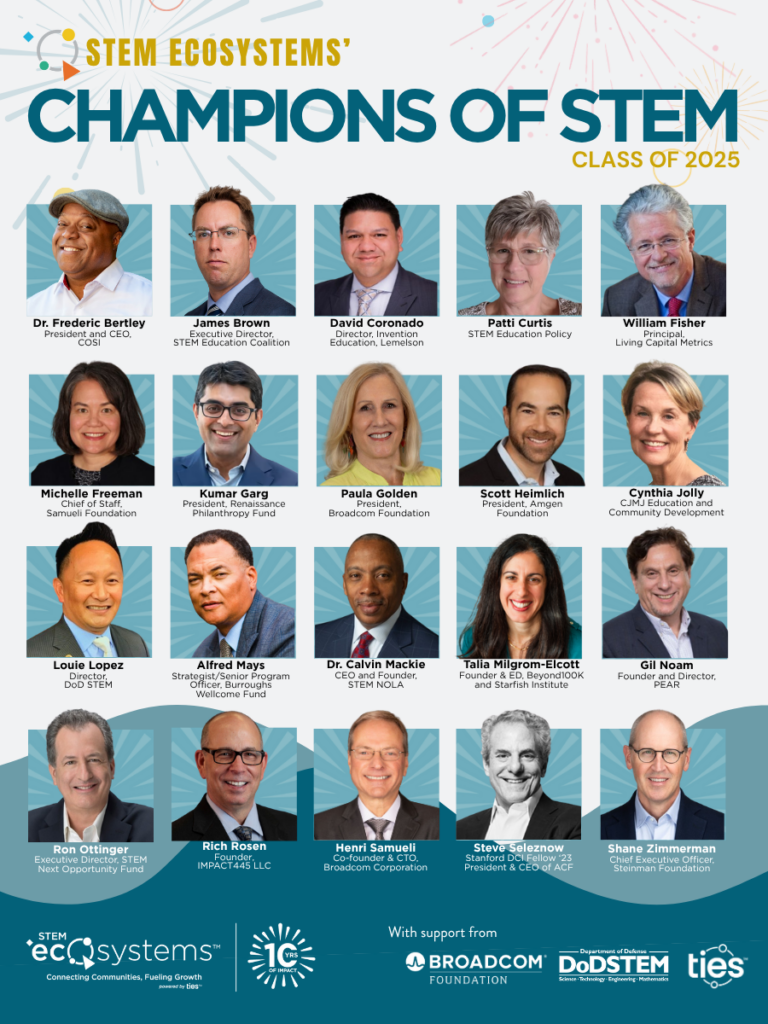
The Champions of STEM Class of 2025 weren’t just leaders—they were pioneers. They saw a fragmented system where brilliant minds were trapped in silos, where students learned about science in isolation from the scientists next door, where businesses sought talent while schools struggled with limited resources just miles away.
And they said, “There has to be a better way.”
The Visionary Leaders
Dr. Frederic Bertley at COSI understood that science centers could become catalysts for community transformation, not just repositories of knowledge. Under his leadership, COSI was named the nation’s #1 science museum for four consecutive years, proving that museums aren’t just places where science lives—they’re places where scientific minds are born. Bertley transformed COSI into a living laboratory for engagement, demonstrating that when informal learning institutions commit to ecosystem thinking, they become powerful engines for developing the next generation of innovators and problem-solvers.
James Brown at the STEM Education Coalition didn’t just advocate for STEM education in Washington—he created a coalition so powerful that suddenly, lawmakers weren’t just talking about STEM; they were investing in it, believing in it, making it a national priority. Representing over 600 business, professional, and education organizations, Brown understood that sustainable policy change required building bridges between sectors that had never worked together before.
David Coronado at the Lemelson Foundation brought invention education to scale, founding InventEd as a national community of practice. His work ensuring that Black, Indigenous, People of Color, women, and low-income students have access to invention education reflects a deep understanding that innovation happens when everyone has the opportunity to create and solve problems. Coronado saw that invention education wasn’t just about building gadgets—it was about building confidence, critical thinking, and the belief that anyone can be an inventor who shapes the future.
The Strategic Foundations
Paula Golden at the Broadcom Foundation stands as the initiative’s most passionate and effective champion, helping establish and shape the very heart of the STEM Learning Ecosystems movement. Serving on the Strategic Advisory Board, she has continually mobilized funders, educators, and communities to work in partnership, always centering the needs of underserved youth and broadening access to transformative STEM opportunities. Golden’s relentless advocacy, signature programs like Broadcom MASTERS®, and visionary leadership have made the STEM Ecosystem initiative a national model—proving that with courage, creativity, and collaboration, entire communities can be reimagined as engines of innovation and lifelong learning.
Kumar Garg, who led STEM education policy in the Obama Administration, saw the disconnect between brilliant innovations and the communities that needed them most. So he built bridges—not just between sectors, but between possibilities and realities, between what works in one place and what could work everywhere. His work creating the Educate to Innovate campaign with over $1 billion in investment and training 100,000 STEM teachers demonstrated how federal policy could harness the power of partnership to achieve transformational scale.
Steve Seleznow brought direct Gates Foundation experience to the movement, having served as program director and deputy director of US Programs at the Gates Foundation, leading implementation of a $2.5 billion education reform strategy. Later, as President and CEO of the Arizona Community Foundation, he applied these lessons to build one of the nation’s most innovative philanthropic organizations.
The Opportunity Creators
Patti Curtis, as the Robert Noyce/Ellen Lettvin STEM Informal Education Fellow at the U.S. Department of Education, worked to ensure that convergence education reached underserved communities. Her experience spanning government, nonprofits, foundations, and museums embodied the cross-sector collaboration the STEM Ecosystem initiative had pioneered.
Alfred Mays at the Burroughs Wellcome Fund served as Chief Diversity Officer and Senior Program Officer for Diversity and Education, overseeing science education programs that provide opportunities for underrepresented minorities in STEM. His work demonstrated that breakthrough discoveries happen when young minds have access to mentors and pathways.
Dr. Calvin Mackie looked at post-Katrina New Orleans and didn’t see devastation—he saw opportunity. He saw young minds hungry for hope and possibility, and communities that could become powerful platforms for STEM learning. Through STEM NOLA, he engaged over 125,000+ students, mostly underserved, proving that ZIP code doesn’t have to determine destiny. Mackie applied the ecosystem model to urban renewal, demonstrating that when entire communities rally around STEM education, they don’t just rebuild—they reimagine what’s possible for the next generation.
The Foundation Leaders
Michelle Freeman at the Samueli Foundation was one of the original architects who helped birth the STEM Ecosystems movement itself. As a founding Program Officer since 2013, she didn’t just witness the initiative’s creation—she helped design it. Freeman understood that lasting change required patient capital—not just financial, but social and political capital invested in relationships that compound over time. Her work reflected a deep understanding that sustainable transformation happens through long-term commitment to community capacity building.
Scott Heimlich at the Amgen Foundation oversaw over $475 million in commitments, with significant focus on biotechnology education through programs like the Amgen Biotech Experience, which reached over one million students. His approach of funding science cultures rather than just programs echoed the STEM Ecosystem’s systems thinking.
Shane Zimmerman at the Steinman Foundation chairs the Lancaster County STEM Alliance and has distributed over $125 million to philanthropic endeavors serving Lancaster County. His work demonstrated how local foundations could become powerful catalysts for regional transformation when they embrace ecosystem thinking. Zimmerman understood that lasting change happens when philanthropic investments create networks of collaboration rather than isolated programs, proving that even county-level initiatives could achieve remarkable scale when built on principles of partnership and shared accountability.
The System Builders
Rich Rosen is a driving force in building the connective tissue across STEM Ecosystems nationwide. As former founding executive director of the Ohio STEM Learning Network, Rosen has played a pivotal role in designing scalable system models and fostering sustainable partnerships among education, business, and industry. His innovative strategies have mobilized engineers and educators to work side by side, transforming how communities nurture STEM talent and creating blueprints now embraced across the country. Rosen ensured the “E” in STEM serves as a bridge across sectors for all learners.
Gil Noam founded The PEAR Institute in 1999, emerging as a national leader in out-of-school time STEM education and the study of youth resilience. Through PEAR, he pioneered influential assessment and quality tools—like the Common Instrument Suite, Dimensions of Success, and Holistic Student Assessment—that have become national standards for measuring STEM program quality and supporting the holistic development of learners. His research and field-building in partnership with major organizations have demonstrated that after-school time, when guided by evidence and caring adults, can be as powerful and transformative as any classroom—turning resilience, engagement, and STEM wonder into lasting success for youth everywhere.
Louie Lopez as Director of DoD STEM brought the precision and mission-clarity of the Department of Defense to STEM education, overseeing programs that reach nearly 944,000 students and 31,000 educators annually. His role demonstrated how ecosystem approaches could be adapted for national security workforce development, understanding that preparing future innovators is actually a matter of both opportunity and strategic importance. Lopez proved that when government agencies embrace partnership-driven models, they can achieve remarkable scale while maintaining the accountability and excellence that mission-critical work demands.
Henri Samueli through the Samueli Foundation committed over $500 million to philanthropic causes with significant focus on STEM education. His startup mindset approach to education brought the same innovative spirit that builds tech empires to rebuilding how we prepare young people for the future. Samueli understood that breakthrough innovation in education required the same risk-taking, systems thinking, and long-term vision that had made him successful as co-founder of Broadcom—proving that entrepreneurial approaches could transform entire communities when applied to learning ecosystems.
Talia Milgrom-Elcott founded Beyond100K, leading a movement that has trained over 108,000 STEM teachers and is now working to prepare and retain 150,000 more, with a focus on equity and belonging. Her national network of nearly 150 organizations answers the urgent need for excellent STEM educators in every classroom, especially those serving the most excluded students. Milgrom-Elcott’s work proves that bold leadership and collaboration can end the STEM teacher shortage and open doors for all learners.
The Community Developers
William Fisher understood that transformation requires measurement—but not just any measurement. His pioneering work on instruments that measure human, social, and natural capital in units traceable to metrological standards provided the STEM Ecosystem movement with crucial accountability frameworks. Fisher saw what others missed: that ecosystem success needed to be quantified across multiple dimensions to prove its value and ensure sustainability.
Cynthia Jolly in K-12 education and community development represented the grassroots educators who bridge the gap between ecosystem vision and classroom reality. Her work in community development and education policy embodied the teacher leadership essential for translating cross-sector partnerships into meaningful learning experiences for students. Jolly knew that when educators become champions who can navigate both pedagogical excellence and community collaboration, ecosystems could actually reach and transform the daily experiences of learners across country.
Ron Ottinger at STEM Next proved that opportunity doesn’t have to be accidental—it can be intentional, systematic, scalable. His leadership of the Million Girls Moonshot, which engaged 2.6 million girls, demonstrated how ecosystem approaches could achieve breakthrough results when communities commit to shared goals. Ottinger co-founded the STEM Funders Network and helped launch the STEM Learning Ecosystems Initiative itself, understanding that lasting change required coordinated action across multiple sectors working toward common outcomes.
The Next Chapter Begins Now
As we celebrate these extraordinary champions at our October 20-22 convening in Washington, D.C.—the most significant gathering in our initiative’s history—we’re not just honoring the past; we’re launching the future. The Marriott Marquis will become ground zero for the next phase of the STEM Ecosystems movement, as over 500 leaders from around the world gather to chart the course for another transformative decade.
Our 10-year anniversary convening represents more than a milestone celebration. It’s a moment of reflection on how far we’ve come and strategic planning for where we’re headed. The beautiful truth about movements is that they don’t end; they evolve, they adapt, they grow stronger with each challenge they overcome and each success they achieve.
The Champions of STEM Class of 2025 didn’t just change how we do STEM education. They changed how we think about what’s possible when visionary dreamers refuse to accept the limitations others see as permanent.
They proved that the future isn’t something that happens to us—it’s something we create, together, one partnership at a time, one student at a time, one impossible dream at a time.
Ten years ago, they dared to reimagine everything.
Today, we get to live in the world they built.
Tomorrow? That’s the next chapter we write together.
Be part of the next chapter. Join us as we celebrate these champions and chart the future of STEM Ecosystems at our 10-Year Anniversary Convening, October 20-22, 2025, Washington, D.C.

